Context / probleemstelling of aanleiding
Probleemstelling (inclusief theoretische onderbouwing en onderzoeksvraag/vragen):
Self-Determination Theory posits that learning environments supporting students’ basic psychological needs (autonomy, competence, relatedness) stimulate their autonomous motivation and well-being. Yet, in higher education, a persistent challenge is that many students experience low or declining motivation, which has been linked to negative well-being outcomes such as heightened anxiety and distress (Park et al., 2012). Sustaining student motivation therefore remains a pressing challenge for universities (Wijnen et al., 2018). Understanding how specific learning environments foster or hinder motivation is crucial to addressing this issue. This study examined students’ basic psychological needs satisfaction, motivation, and well-being across distinctive learning environments, and explored how programme characteristics contributed to students’ autonomy, competence, and relatedness.
Methode:
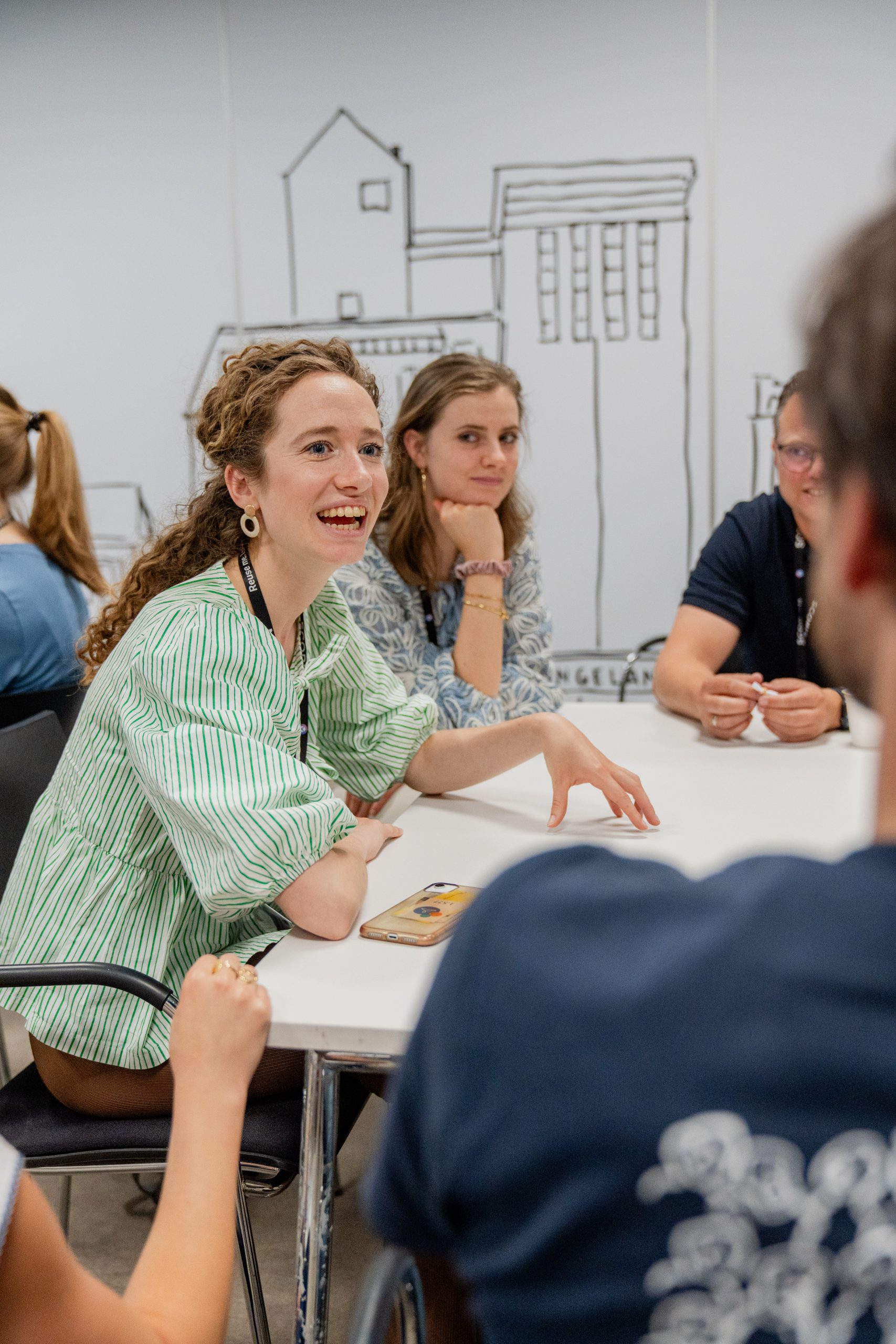
We conducted a survey (N=202) to measure first-year students’ basic psychological needs satisfaction (autonomy, relatedness, and competence), motivation (autonomous motivation, controlled motivation, and relative autonomous motivation) and well-being across three Bachelor’s programmes (A, B, C). All programmes used a student-centered Problem-based Learning approach. Programmes A and B offered pre-determined courses, while C allowed course selection in the second semester and included a research project where students chose a topic of interest. Additionally, we conducted focus groupswith students from each programme (N=4, 4, 3) respectively, to explore students’ experiences and perceptions of autonomy, competence, and relatedness in their learning environments. Quantitative results were analyzed using ANOVA and qualitative data using thematic analysis. These results were integrated when interpreting the findings.
Resultaten (en conclusie):
Students experienced different degrees of autonomy satisfaction, autonomous motivation and relative autonomous motivation in learning environments of distinctive characteristics. Programme A students had a lower score than Programme C’s in autonomy satisfaction (mean = 3.4 vs. 3.7, p = 0.017, η<sub>part</sub><sup>2</sup> = 0.039). They also had lower scores than Programme B’s in autonomous motivation (mean = 5.0 vs. 5.5, p = 0.008, η<sub>part</sub><sup>2</sup>= 0.039) and relative autonomous motivation (mean = 1.3 vs. 3.8, p < 0.001, η<sub>part</sub><sup>2</sup>= 0.070). Focus group results revealed that learning environments providing freedom and support for choosing topics of interest fostered students’ autonomy satisfaction, while insufficient guidance hindered it. Acquiring knowledge, small-group collaborations, peer connections, and real-life relevant learning activities stimulated autonomous motivation, while assessments not reflecting deep understanding hampered it.
Discussie (beschouwing resultaten en conclusie in het kader van de theorie):
Our findings provide empirical support for Self-Determination Theory, showing that learning environments that offer freedom of choice, foster relatedness, and enhance meaningful engagement—when combined with appropriate guidance—promote autonomy satisfaction and autonomous motivation. To enhance autonomous motivation, programmes need to offer students choice with appropriate guidance, facilitate peer collaboration, ensure assessments reflect deep learning, and integrate real-life relevant problems. These practical insights can guide programme design to better support students’ basic psychological needs and sustained motivation.
Referenties:
Park, J., Chung, S., An, H., Park, S., Lee, C., Kim, S. Y., Lee, J.-D., & Kim, K.-S. (2012). A structural model of stress, motivation, and academic Performance in medical students. <i>Psychiatry Investigation</i>, <i>9</i>(2), 143–149. https://doi.org/10.4306/pi.2012.9.2.143
Wijnen, M., Loyens, S. M. M., Wijnia, L., Smeets, G., Kroeze, M. J., & Van der Molen, H. T. (2018). Is problem-based learning associated with students’ motivation? A quantitative and qualitative study. <i>Learning Environments Research</i>, <i>21</i>(2), 173–193. https://doi.org/10.1007/s10984-017-9246-9